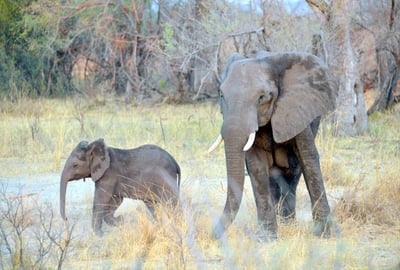
Elephant
The world's largest land mammal. Namibian elephants live in small family groups of 10–20, often congregating in larger herds at communal waterholes led by dominant females.
Read more
Embark on a journey unlike any other as we transport you straight to the heart of Etosha National Park, where the magic of Namibia's wilderness unfolds before your very eyes, 24/7. Our live webcam serves as your exclusive portal to the legendary Okaukuejo Waterhole, a beacon of life in the arid landscapes of the park.
Witness nature's drama unfold under the vast Namibian sky, bathed in the gentle glow of floodlights. From the iconic presence of elephants to the elegant grace of giraffes, from the playful antics of zebras to the stealthy prowling of lions, the Okaukuejo Waterhole teems with a breathtaking array of wildlife, particularly during the parched months when water is scarce.
In Etosha National Park, where the savanna desert climate keeps water precious, nature has adapted in extraordinary ways. Guests may witness:
The world's largest land mammal. Namibian elephants live in small family groups of 10–20, often congregating in larger herds at communal waterholes led by dominant females.
Read more/23-06-16%20rhinoceros%20black%20gemsbokvlakte%20etosha%20-%20wikipedia%2012-01%20cut%20web%20850%20x%20567.jpg?width=400&height=300&name=23-06-16%20rhinoceros%20black%20gemsbokvlakte%20etosha%20-%20wikipedia%2012-01%20cut%20web%20850%20x%20567.jpg)
One of two African rhino species, the hook-lipped black rhino is a critically endangered browser and one of Etosha's most iconic nocturnal waterhole visitors.
Read more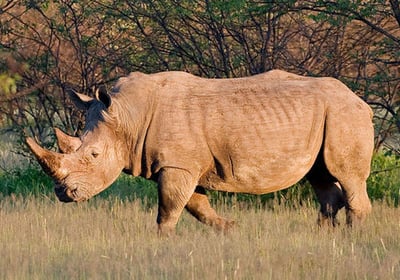
Africa's third largest land mammal, the square-lipped white rhino has a barrel-shaped body and continually growing horns — one in front and a shorter one behind.
Read more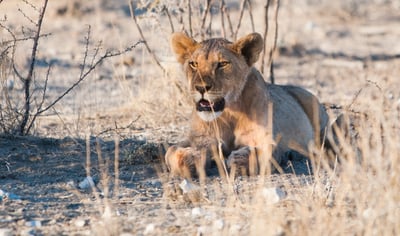
Living in prides of up to 30 individuals, lions are great wanderers. Lionesses remain in the pride for life and do the majority of the hunting.
Read more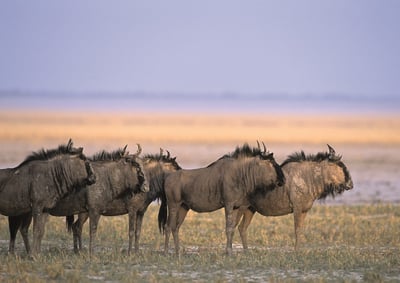
Standing 1.4 m at the shoulder and weighing up to 200 kg, both sexes carry curving horns, a grey coat, black mane and black beard.
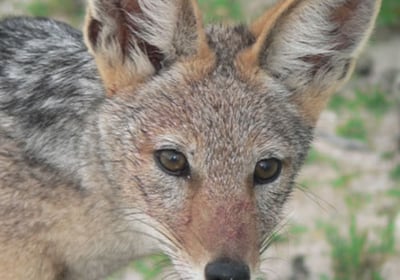
A medium-sized predator with distinctive black fur sprinkled with white along its back — wider at the neck and narrowing toward the tail, almost like a saddle.
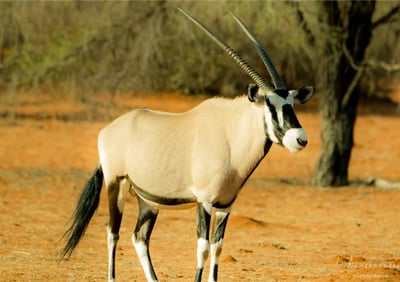
The largest of the three oryx species, with a light brown/grey coat, black leg markings, and distinctive black-and-white facial markings making them instantly recognisable.
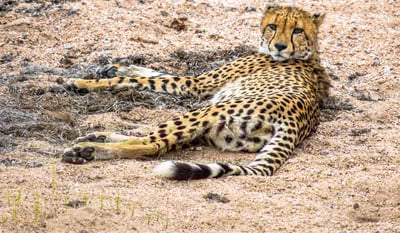
Built for speed with a slim body and long legs, the cheetah can reach 120 km/h. Its distinctive "tear tracks" running from eye to mouth make it easy to identify.
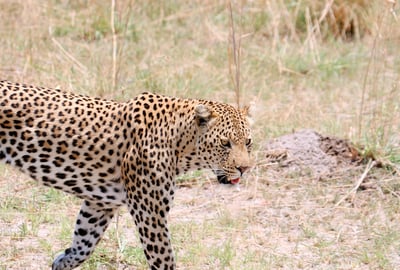
Primarily nocturnal and highly secretive, leopards are solitary except during mating season. Their repeated hoarse rasping cough is often heard before they are seen.
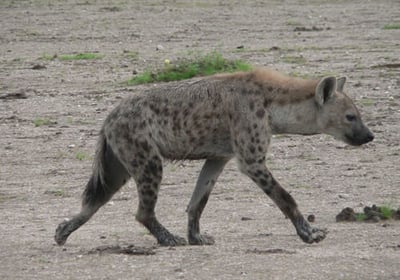
Far more than scavengers, hyenas are efficient hunters with powerful jaws. Female-led clans can run at up to 60 km/h.
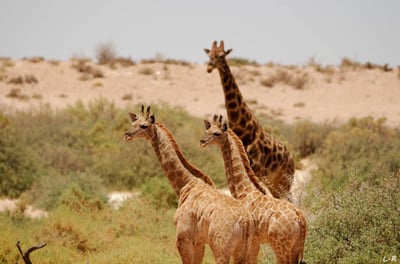
The world's tallest animal at up to 6 metres. Recent studies have identified four distinct giraffe species across Africa.
Read more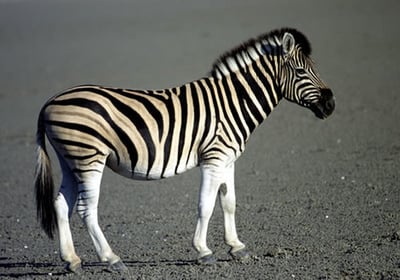
Named after naturalist W.J. Burchell, these savannah zebras form family groups that gather in vast herds of hundreds at shared waterholes.
Read more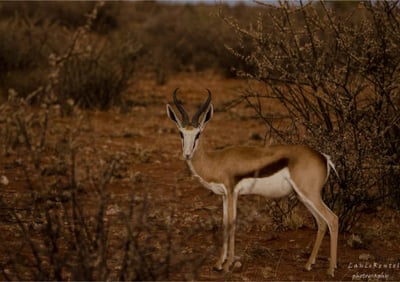
One of Africa's fastest antelopes at up to 88 km/h, the springbok is also famous for its unique pronking — leaping up to 4 metres straight into the air.
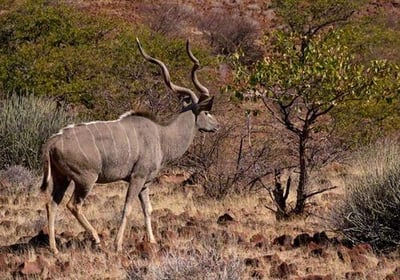
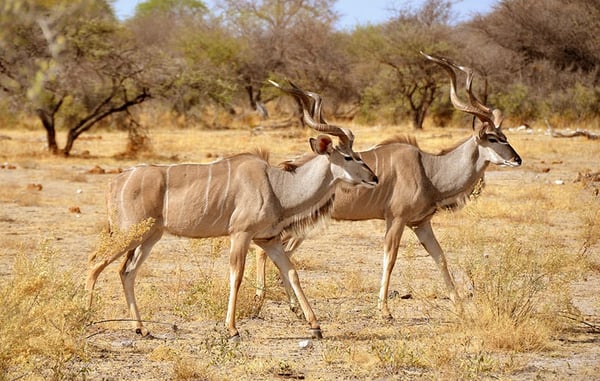
The greater kudu (Tragelaphus strepsiceros) is found throughout central & northern Namibia and is the second tallest antelope on the African continent. Kudu bulls bear long, spiral horns which reach record lengths of up to 1.8m. Horns grow to their full length at the age of six years. Kudu live in small herds not usually larger than twelve, comprising of females and their young.
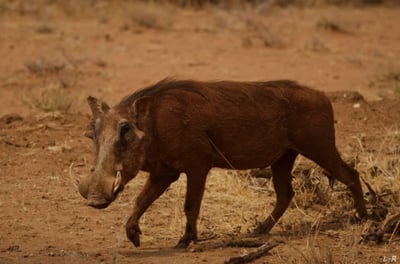
The warthog is an African pig with large curved tusks protruding from its huge flattened head, one set from both upper and lower jaws. It gets it name from the gristly warts that protrude from the sides of its face. Boars have two pairs, sows only one. It is not known for certain what purpose the warts serve.
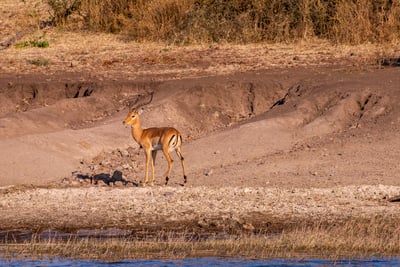
Impala (Aepyceros melampus) favour woodlands, sheltering an undergrowth of grass or shrubs. They are seldom far away from water, hence their Namibian distribution patterns. They are very common in their range and a characteristic of impala is the attendance of red-billed oxpeckers busily cleaning and generally keeping impala free from ectoparasites, although they do self-groom with their lower incisors to remove ticks.
At sunrise, the gates open to the Great White Place — as the Owambo people have called Etosha since time immemorial. In the 22,912 km² wilderness, wildlife thrives in remarkable ways.
After a day of adventure, visitors can unwind at Etosha Safari Lodge, Etosha Safari Camp, The Ekipa for a luxurious retreat, Etosha Safari Camping2Go, or the Etosha Safari Campsite — whether on a sundowner deck, at the lively Oshebeena Bar, or in a cosy canvas tent. These accommodation options are ideally located just 10 km from the Andersson Gate.
Further north-east, Etosha King Nehale offers its own serene retreat right outside the King Nehale Gate, perfectly positioned for exploring the eastern side of the park.
.jpg?width=800&height=533&name=Etosha%20King%20Nehale%20(1).jpg)
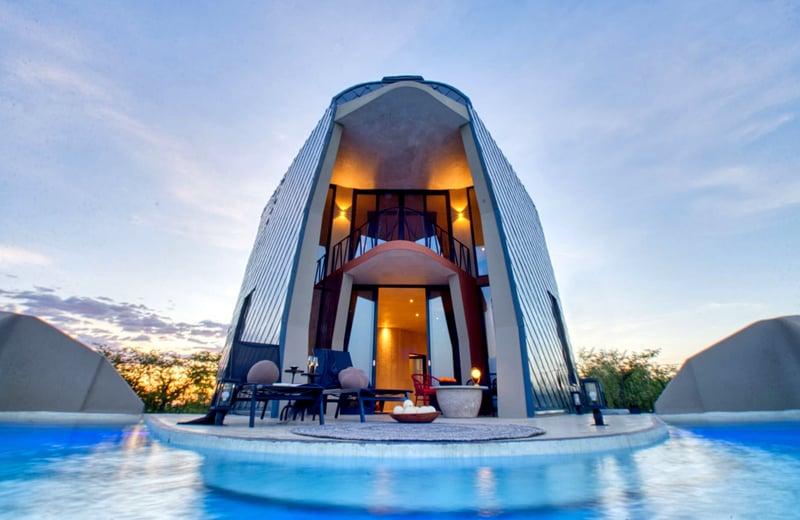
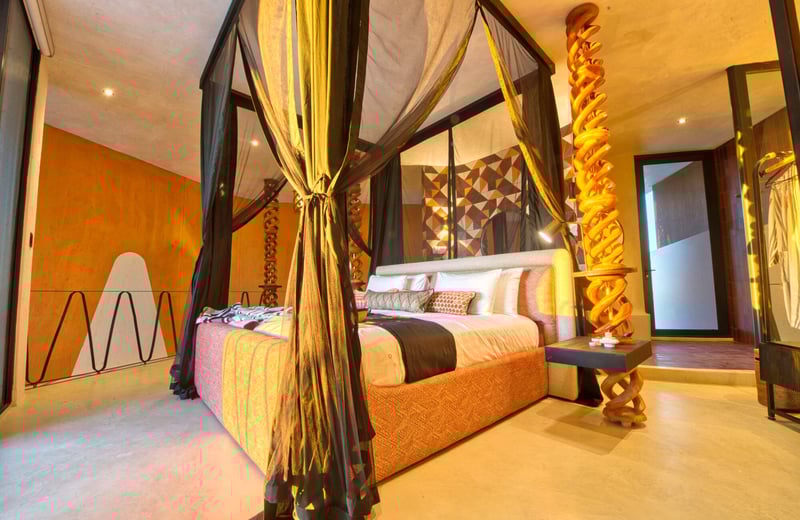
.jpg?width=800&height=533&name=Etosha%20Safari%20Lodge%20(1).jpg)
.jpg?width=800&height=533&name=Etosha%20Safari%20Camp%20(4).jpg)
Etosha evolved from a colonial hunting control station into one of Namibia's key conservation areas. Okaukuejo is now the park's administrative and research centre — its flood-lit waterhole allows safe wildlife viewing in person and via platforms like the NamibiaCam YouTube channel.
.jpg?width=600&height=400&name=Etosha%20Safari%20Campsite%20(8).jpg)
Established in 1896 as a hunting control outpost, Etosha has transformed into a world-class conservation site. The Etosha Ecological Institute drives biodiversity research — covering wildlife, insects, birds, and the environmental history of the pan itself.
Covering 4 730 km² — about 21% of the entire park — the Etosha Pan is a vast dried-up lake that creates a fascinating and unique ecosystem. Its name, meaning "Great White Place", is a perfect description of this ancient, shimmering landscape.
The camera is located at the Okaukuejo Waterhole, situated at the Okaukuejo Rest Camp within Etosha National Park in north-central Namibia.
Have a look at our Animals in the area section above for the full list of species regularly spotted at the waterhole.
Okaukuejo waterhole is famous for its game viewing. Predators that can be seen include Lions, Cheetah, Leopard, and Spotted and Brown Hyenas.
Okaukuejo offers diverse sightings including Rhino, Giraffe, Elephant, and Lion — making it one of southern Africa's premier wildlife viewing spots.
These rocks originate from limestone (calcium carbonate), formed by the evaporation of groundwater bringing carbonates and salts from the underlying rock strata and sediments to the surface — a direct result of the Etosha Pan's ancient lake history.
No — the waterhole is maintained by a solar-powered borehole system, ensuring a reliable water source for wildlife year-round.

We are unique. We are passionate. We are Namibian. Most importantly, we are Gondwana.
Do you love tuning in to the Namibia Cam live streams? Become a Namibia Cam member and help preserve both the streams and Namibia’s wildlife starting from just €0.99 per month.
*Membership is applicable to YouTube approved countries only.