
Serving both as a refresher for employees who attended the 2024 session and as an introduction for new participants, a Snake Awareness and Safe Handling Training was hosted on 5 to 6 March 2026 at Gondwana’s Canyon properties.
The training, facilitated by Francois Theart from Snakes of Namibia with assistance from Kersti Engelking, aimed at build confidence, useful knowledge and preparedness when safely managing encounters with venomous snakes.
Understanding snakes in the canyon
The training placed strong emphasis on awareness and behaviour of the two species used for demonstrations: Puff adder (Bitis arietans) and Zebra snake (Naja nigricincta).
While puff adders and other adder species naturally occur in the Fish River Canyon area, zebra snakes do not range this far south. However, the region is home to a closely related subspecies, such as the black spitting cobra (Naja nigricincta woodi), which shares the zebra snake’s ability to accurately spit venom up to three metres.
Francois explained that these snakes, prefer to escape when possible and steer clear of confrontation, typically spitting only when threatened.
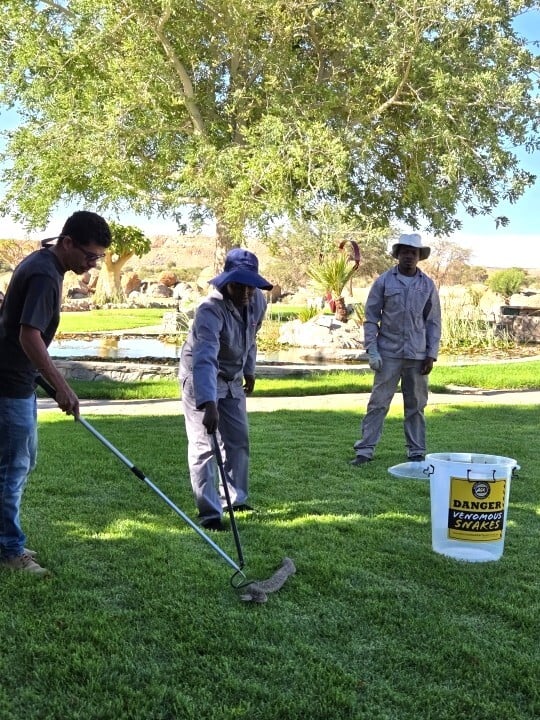
Snake training at Canyon Lodge
Sharing an ecological standpoint, Francois highlighted the roles snakes essentially play in ecosystems. They help regulate rodent and insect populations, contribute to disease control and serve as prey for other wildlife. In addition, their venom also plays a role in advancing human medical research.
Furthermore, guiding through common misconceptions – in that snakes do not chase people; they generally try to move away and that a snake’s tail, often believed to be dangerous, cannot sting or bite. The clarifications helped reduce fear and build confidence among participants.
Both the recognition of these ecological benefits and debunking myths around snakes through accurate knowledge align with Gondwana Collection’s sustainability policy to reinforce the shared commitment to biodiversity conservation, including the safe capture and release of snakes into nature.
Practical guidance on snakebite response
Crucial first-response guidelines for a snakebite emergency were provided. One of the most important instructions was never to tie off the affected limb. Reason being, restriction to blood flow leads to venom concentration, and removing the tie may release a dangerous surge into the body, possibly leading to serious damage to tissues and loss of the limb.
Instead, the right approach is to raise the bitten limb to a higher position, seek immediate medical attention, and immediate call for additional aid such as contacting Francois or Dr. Christo Buys for guidance to assist with accurate treatment information and procedure.
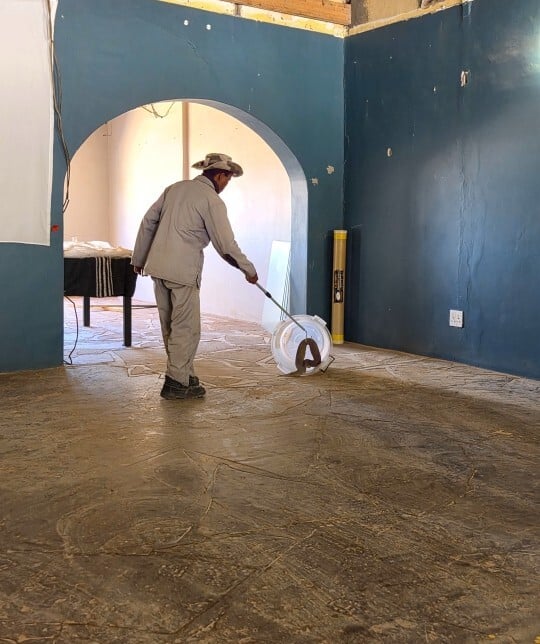
Snake training at Canyon Roadhouse
Safe capture and handling
After the awareness session, the team moved into practical training using the two live snake species, where participants learned to handle snakes using snake tongs, snake hooks, buckets with secure lids, and PVC (Polyvinyl Chloride) snake tubes.
Skills that help ensure the well-being of employees, guests, and the animals themselves were included; this meant guiding snakes into containers safely and effectively.
Beyond the training, the employees at Gondwana's Canyon Lodge, Canyon Roadhouse and Canyon Village were also encouraged to share their knowledge learned with their home communities and fellow colleagues to spread awareness and promote a more conservation-minded attitude towards snakes, and ultimately safer environments for people, animals and snakes.
Images: Gondwana Collection Namibia

SUBMIT YOUR COMMENT