
Imagine a future where ecological and financial growth share the same roots. Where strong returns and sustainable impact grow side by side. This is the tangible promise now sprouting at Damara Mopane Lodge, near Khorixas.
The vision is clear: to establish a climate-resilient, scalable plantation that drives environmental regeneration while pioneering sustainable land use. At its core, the initiative seeks to create a reliable, long-term project that contributes positively to ecosystems, closely aligned with the global shift towards eco-conscious and impact-driven investment.
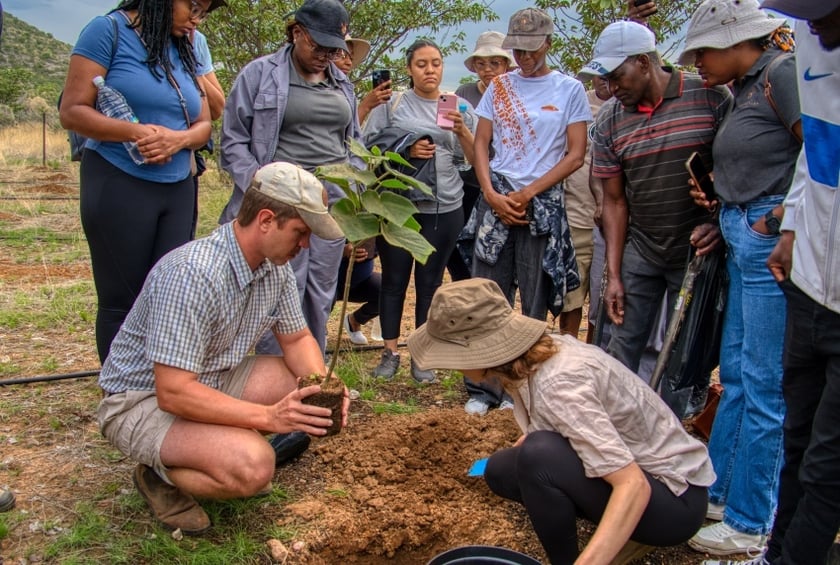 Gondwana Collection team members and community members from Khorixas show how to correctly plant the Kiri trees by AVAGROW.
A Vision Rooted in Regeneration and Return
The Kiri Tree Planting Project, a strategic collaboration between Gondwana Collection Namibia and AVAGROW, has officially entered its first phase. The initiative was driven by Bernd Grahl, Gondwana Collection Namibia’s Group Digital Manager, working closely with the company’s Environmental and Social Impact team.
Recently, 30 Gondwana Collection team members, joined by 16 community members from the nearby town of Khorixas, came together to plant 435 Kiri trees, one of the world’s fastest-growing hardwood species.
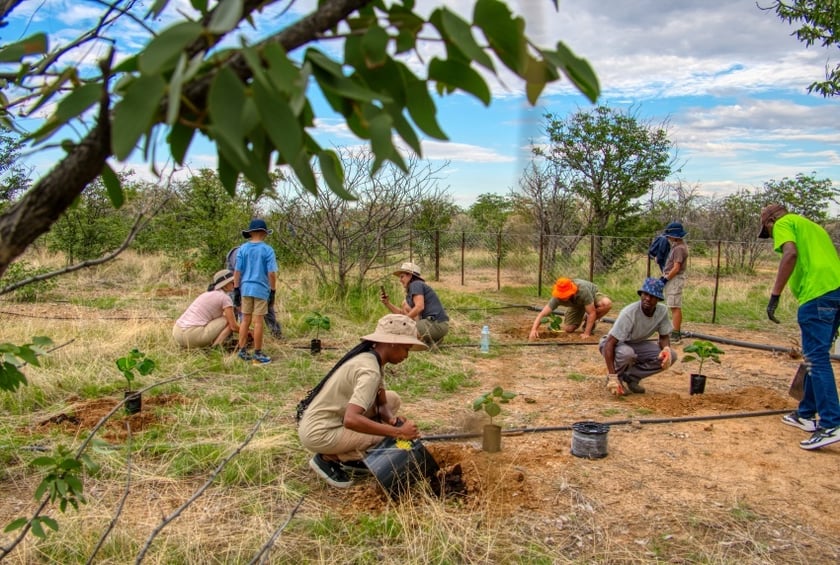 first phase of the Kiri Tree Plantation Project kicks off at Damara Mopane Lodge
The non-invasive Kiri trees were planted in open areas; carefully integrating them among the existing Mopane woodland and other native species, ensuring the natural landscape remains intact and biodiversity is respected.
To further reduce environmental pressure, the trees are irrigated using recycled water. This eases demand on groundwater reserves and gives treated water from the lodge a sustainable new purpose. For years, recycled water has been used to water the property's lawns, gardens and now, Kiri tree plantation.
Approximately 1.2 tonnes of biochar, acquired through Pyronam, a charcoal like material made from plant waste mixed with manure, has been used in the planting phase to support the soil composition and promote climate resilience due to its water and nutrient retention properties.
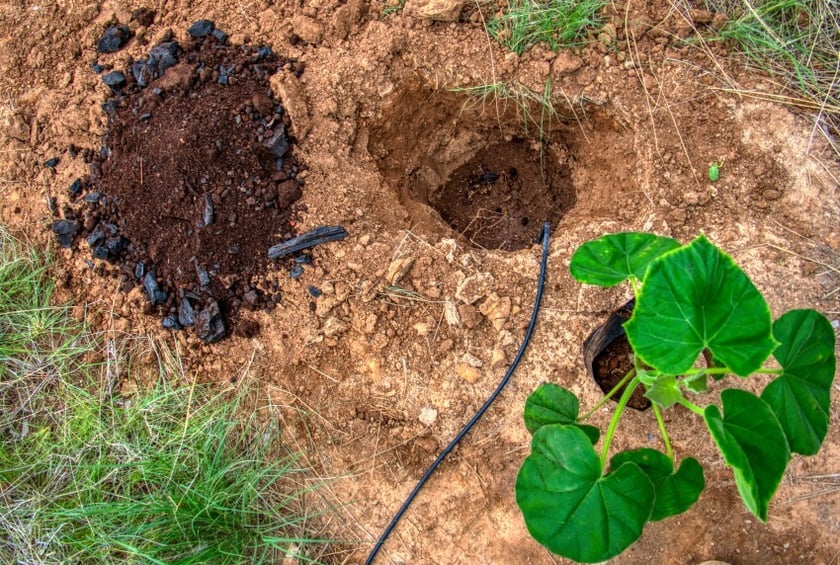
Using biochar, a charcoal like material made from plant waste mixed with manure used in the planting phase.
Blueprint for the future
Kiri trees can reach maturity within five to seven years, producing lightweight yet durable timber increasingly sought after for furniture, construction, and specialised manufacturing. Unlike conventional forestry, Kiri trees regenerate after harvesting, require less water, and actively improve soil quality, making them well suited to Namibia’s semi-arid conditions.
The initial planting at Damara Mopane Lodge is only the beginning. The project is designed to scale into a 3,000-tree Kiri plantation, establishing a proven model that combines environmental stewardship with commercial viability.
As environmental, social, and governance considerations increasingly shape global investment decisions, initiatives like the Kiri Tree Planting Project point to a new future for African forestry: one that is scalable, climate-smart, and commercially viable.

SUBMIT YOUR COMMENT